

There are some things I make from scratch because I want to have simple ingredients.
And then there are things I make from scratch because I want to know if I’m actually saving money.
Cinnamon rolls are a little of both.
They’re one of those foods that can feel like a special treat, but they’re also surprisingly simple to make at home. So, I wanted to find out:
Is making cinnamon rolls from scratch actually worth the cost?
Not just the cost of the ingredients, but the overall value.
What am I spending?
What ingredients am I getting?
And how does that compare with buying them already made?
That’s what we’re looking at in this round of Homemade vs. Store-Bought.
Let’s Talk Ingredients:
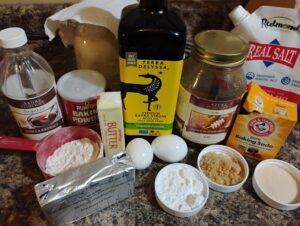
One of the things I like most about making food from scratch is how simple the ingredient list can be.
My cinnamon roll recipe uses ingredients like:
Flour
Sourdough Starter
Olive Oil
Honey
Eggs
Baking Soda
Baking Powder
Salt
Butter
Brown Sugar
Cinnamon
Cream Cheese
Vanilla
Powdered Sugar
There’s nothing particularly exotic here.
Most of these are ingredients I already keep in my kitchen or use regularly for other recipes.
And that’s important when I’m thinking about the overall cost of homemade food.
I’m not buying a specialty ingredient that I’m only going to use once.
I’m buying ingredients that can be used over and over again.
A bag of flour doesn’t jus tmake cinnamon rolls.
A jar of honey doesn’t just make one recipe.
The same butter, eggs, sugar, cinnamon, vanilla, and other pantry staples can be used throughout the week.
So when I look at the price of a package at the grocery store, I don’t want to compare that directly with the price of buying every ingredient needed to make something homemade.
That’s not really an apples-to-apples comparison.
Instead, I want to know how much of those ingredients actually went into my batch.
The Cost of Homemade
This is where homemade gets interesting.
I recently priced out the ingredients I use for these cinnamon rolls.
Here’s what I am paying for the ingredients in my kitchen right now, these of course fluctuate depending on if our chickens are laying and where I am sourcing the ingredients from. Typically, it is either Walmart or Azure Standard where I am that gives me the best deal:
Flour- $30 for 25 pounds
Butter- $3 for 1 pound
Eggs- 8$ for 60
Sugar- $5.77 for 4 pounds
Salt- $8.26 for 26 ounces
Vanilla- $17.49 for 16 ounces
Baking soda- $1.49 per pound
Baking powder- $3.26 for 8oz
Olive oil-$13.62 for 34oz
Brown sugar- $1.98 for 32oz
Powdered sugar- $1.98 for 32oz
Cinnamon- $9.98 for 1lb
Cream cheese- $2.23 for 8oz
Honey- $13.59 for 3 pounds
Those prices can look intimidating when you see them all together.
But here’s the important part:
I don’t use all of that to make one batch of cinnamon rolls.
I use a portion of each ingredient.
That’s why I think it’s important to look at the cost per recipe, rather than simply adding up everything you had to purchase.
The ingredients sitting in my pantry aren’t a one-time expense.
They’re an investment in multiple meals, desserts, breads, and recipes.
The Real Question: Is Homemade Cheaper?
This is where I think homemade gets misunderstood.
Sometimes homemade is cheaper.
Sometimes it isn’t.
And sometimes the difference is small enough that the decision comes down to more than just the price.
For me, the question isn’t necessarily:
“Can I make cinnamon rolls for less money than the cheapest cinnamon rolls at the grocery store?”
It’s
“What am I getting for the money I spend?”
When I make them myself, I’m getting a whole batch of cinnamon rolls made with ingredients I chose.
I’m also buying ingredients that can be used for other things.
And I have control over the recipe.
I can make them sweeter, less sweet, more buttery, more cinnamony, or pile on as much cream cheese frosting as my heart desires.
But What About the Time?
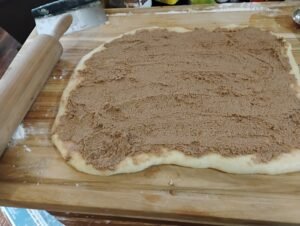
This is the part we can’t ignore.
Homemade isn’t free just because the ingredients are inexpensive.
There’s time involved.
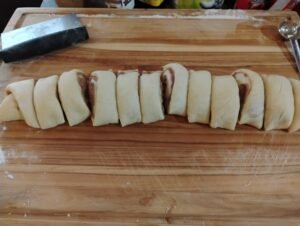
There’s mixing.
There’s measuring,
There’s making the dough.

There’s cleanup.
And in my case, there’s usually flour in places flour was never supposed to be.
So I don’t think homemade should automatically be considered better simply because it’s homemade.
The time has value too.
Homemade vs. Store-Bought: The Bigger Picture
For me, the biggest difference between homemade and store-bought cinnamon rolls starts with health-not because homemade cinnamon rolls suddenly become a health food, but because making them myself gives me more control over what goes into them.
They’re still a dessert.
They still contain butter, sugar, flour, and cream cheese frosting.
But when I made them at home, I know the ingredients I’m using. I can choose the flour, the sweetners, the fats, and the toppings. I can adjust the sweetness, skip ingredients I don’t want, and avoid relying on a finished product with a long ingredient list or additives I may not recognize.
That doesn’t automatically make homemade healthy.
It does make the food more transparent.
I know what I’m serving my family, and I have the ability to make choices that fit our preferencfes and needs. FOr me, that control is one of the strongest reasons to make them from scratch.
The financial side matters too.
If I already have many of the ingredients on hand, the actual cost of one batch can be reasonable especially when that batch makes several cinnamon rolls. I’m not paying only for one finished package. I’m also purchasing ingredients that can be used in other meals, desserts, breads, and recipes.
Of course, store-bought cinnamon rolls are paying for convenience. There are days when avoiding the mixing, measuring, rising, baking, and cleanup is worth the extra cost.
But when I have the time, homemade gives me more control over the ingredients first, and potentially more value for my money second.
That’s really the bigger picture for me.
Now whether homemade is always healthier.
Not whether homemade is always cheaper.
But whether the combination of ingredient control, transparency, flexibility, and cost makes it worth the effort.
And for cinnamon rolls, I think it does.
Homemade vs. Store-Bought Price Comparison
To make the comparison a little clearer, I wanted to look at the cost of the cinnamon rolls themselves rather than the total cost of purchasing every ingredient at once.
The homemade prices reflect the estimated cost of the ingredients used in one batch. The store-bought prices reflect what I would pay for a comparable package of prepared cinnamon rolls.
| Homemade-12 rolls | Meijer- 4 rolls | Walmart-8 rolls | Aldi-8 rolls | Kroger-4 rolls |
| $10 | $6.49 | $4.47 | $4.15 | $6.99 |
Homemade vs. Store-Bought: Difference in ingredients
I’m not trying to convince anyone that homemade cinnamon rolls are healthy.
They’re not.
They’re a dessert.
But there’s a difference between looking at a list of ingredients and actually knowing what those ingredients are.
When I make them at home, I know I’m using flour, butter, eggs, honey, sugar, cinnamon, cream cheese, and the other basic ingredients that go into the recipe.
I don’t have to wonder what’s in the dough.
I don’t have to buy a finished product and accept whatever ingredients were chosen for me.
And for me, that’s one of the biggest benefits of cooking from scratch.
| Homemade | Walmart |
| Flour, olive oil, honey, eggs, baking soda, baking powder, salt, butter, brown sugar, cinnamon, cream cheese, powdered sugar, vanilla. | ENRICHED FLOUR (NIACIN, IRON, THIAMIN MONONITRATE, RIBOFLAVIN, ENZYME, FOLIC ACID), CREAM CHEESE ICING (SUGAR, VEGETABLE SHORTENING [PALM OIL, CANOLA OIL, MONO- AND DIGLYCERIDES, POLYSORBATE 60], CREAM CHEESE [PASTEURIZED MILK AND CREAM, SALT, CAROB BEAN GUM, CHEESE CULTURE], DEXTROSE, WATER, CORN SYRUP, HIGH FRUCTOSE CORN SYRUP, CREAM CHEESE POWDER [CREAM, NONFAT MILK, SALT, SODIUM ALGINATE, LACTIC ACID, CORN SYRUP SOLIDS, SODIUM CASEINATE {MILK}, NATURAL FLAVOR], NATURAL AND ARTIFICIAL FLAVOR, CORN STARCH, SALT, SOYBEAN OIL, BENZOIC ACID [PRESERVATIVE], SODIUM BENZOATE [PRESERVATIVE], POTASSIUM SORBATE [PRESERVATIVE], POLYSORBATE 60, ARTIFICIAL COLOR), WATER, SUGAR, SOYBEAN OIL, CINNAMON ICING (SUGAR, VEGETABLE OIL [COCONUT OIL, SOYBEAN OIL], WATER, CORN SYRUP, HIGH FRUCTOSE CORN SYRUP, CORN STARCH, ARTIFICIAL COLOR, SOYBEAN OIL, PALM OIL, MILK POWDER, CINNAMON, MONO-AND DIGLYCERIDES, SUCROSE FATTY ACID ESTERS, SALT, SOY LECITHIN, NATURAL FLAVOR, POTASSIUM SORBATE [PRESERVATIVE], CITRIC ACID, POLYSORBATE 60), LIQUID EGG WHITES, YEAST (SORBITAN MONOSTEARATE, SORBIC ACID), PALM OIL SHORTENING, CINNAMON, CORN SYRUP, SALT, LEAVENING (SODIUM ACID PYROPHOSPHATE, SODIUM BICARBONATE, MONOCALCIUM PHOSPHATE), MONOGLYCERIDES (AN EMULSIFIER), SOY LECITHIN (AN EMULSIFIER), INVERT SUGAR, ENZYMES, COCOA POWDER, CALCIUM PROPIONATE (PRESERVATIVE), SODIUM PROPIONATE (PRESERVATIVE). |
My Final Take

So, are homemade cinnamon rolls worth it?
For me,yes.
Not because homemade is always cheaper. Not because a cinnamon roll is suddenly healthy just because I make it in my own kitchen.
It’s because I can look at the cost, look at the ingredients, and decide for myself whether it’s worth the effort.
I get to use simple ingredients that I recognize, control what goes into the recipe, and make something for my family from scratch.
And honestly, that’s what this whole series is really about.
I’m not trying to prove that homemade is always better.
I’m trying to figure out when homemade is actually worth it.
Sometimes the answer will be yes.
Sometimes the convenience of store-bought will win.
But when I can save money, use simple ingredients, and make something my family enjoys?
That’s a win in my book.
And if it leaves a little flour on the counter and a little cinnamon sugar on the floor…
Well, that’s just part of the Grateful Mess.
*Cinnamon roll recipe can be found at Sourdough, Recipes, Homesteading and More! – Farmhouse on Boone